
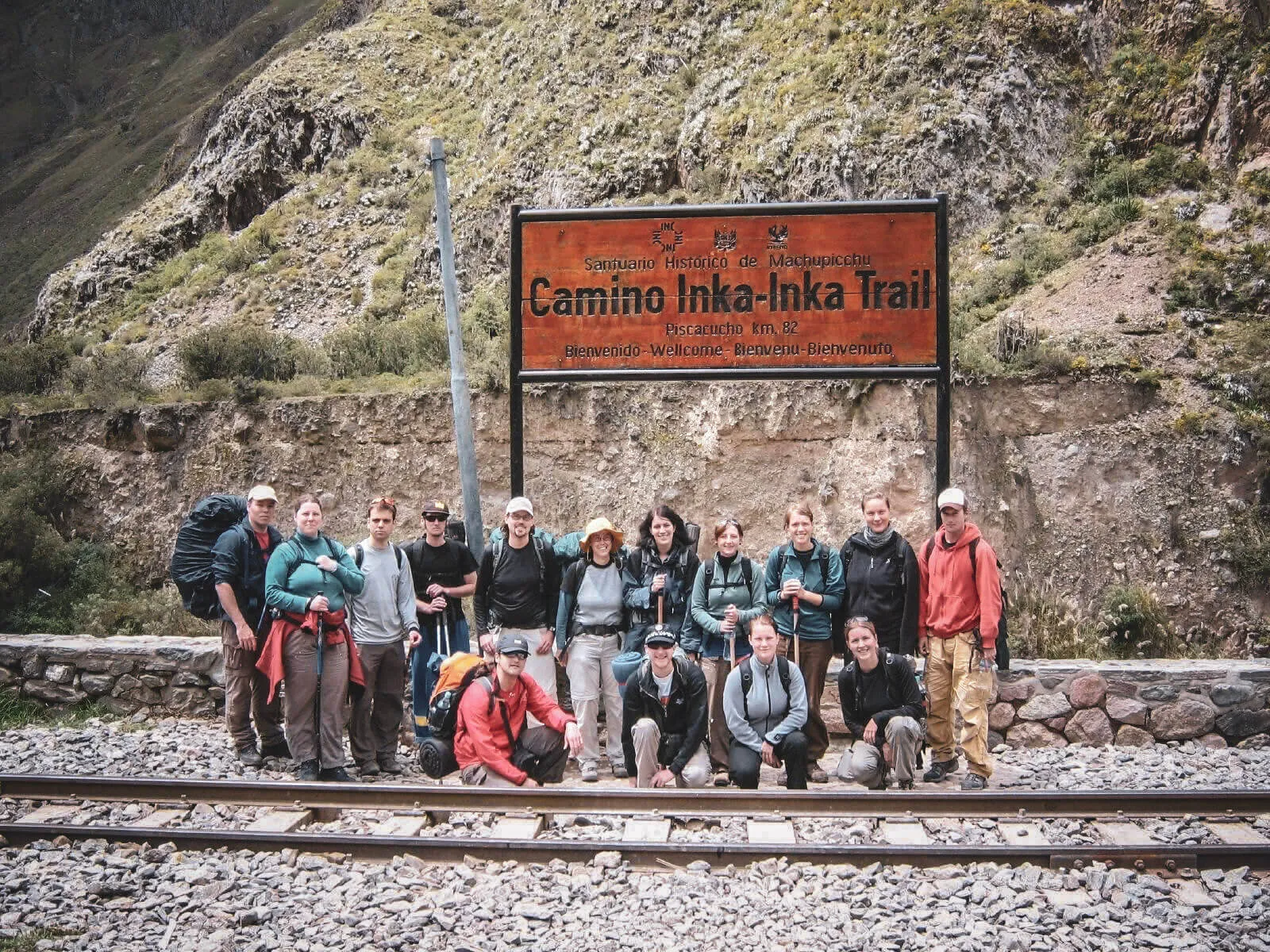
Hikers following the Short Inca Trail toward Machu Picchu Hikers crossing the mountain landscape of the Classic Inca Trail

Short approach or complete expedition?

2-Day vs 4-Day Inca Trail

Choose two days for limited time, hotel comfort and a shorter hike. Choose four days for the complete trek, more archaeology, high passes and three nights of camping.

Route 5 vs Route 1Reviewed August 5, 2026Official and practical distances separated

Neither route is a lesser version of the other.

The Short Trail concentrates the final historic approach into one main hiking day. The Classic Trail makes the journey itself central to the experience. Your available time, camping preference, fitness and permit date should decide.

Check both permit routes

Side-by-side

The essential differences

Compare equivalent characteristics before comparing operator packages.

Comparison2-Day Short Inca Trail4-Day Classic Inca Trail
Best forLimited time, hotel comfort and a shorter challengeA complete trek, greater immersion and more archaeology
Official access routeRoute 5 · Chachabamba / Km 104Route 1 · Piskakuchu / Km 82
Trail timeOne principal hiking dayFour consecutive hiking days
Official listed distance10.5 km / 6.5 mi33.7 km / 20.9 mi
Common operator/GPS totalApprox. 12–15 km / 7.5–9.3 miApprox. 42–46 km / 26–29 mi
Highest terrainWell below the Classic route’s main passDead Woman’s Pass · approx. 4,215 m
DifficultyModerate, with a sustained climb and stone stepsChallenging to strenuous over repeated days
AccommodationUsually one Aguas Calientes hotel nightThree nights of camping
Key sitesChachabamba, Wiñay Wayna and Inti PunkuA broader archaeological sequence plus those final sites
Sun Gate timingNormally afternoon on hiking dayNormally early on the final morning
Support modelGuide, transport and hotel-based logisticsGuide, cooks, porters and camping logistics
Typical costLower, but rarely half the Classic priceHigher because of staffing, food and camps
Main compromiseLess trail, altitude and archaeologyMore exertion, time and outdoor discomfort

Same final corridor, different journey

Km 104 joins near the end of the Classic route

Both routes include Wiñay Wayna and Inti Punku, but only the Classic Trail crosses the earlier valleys, passes and archaeological sequence.

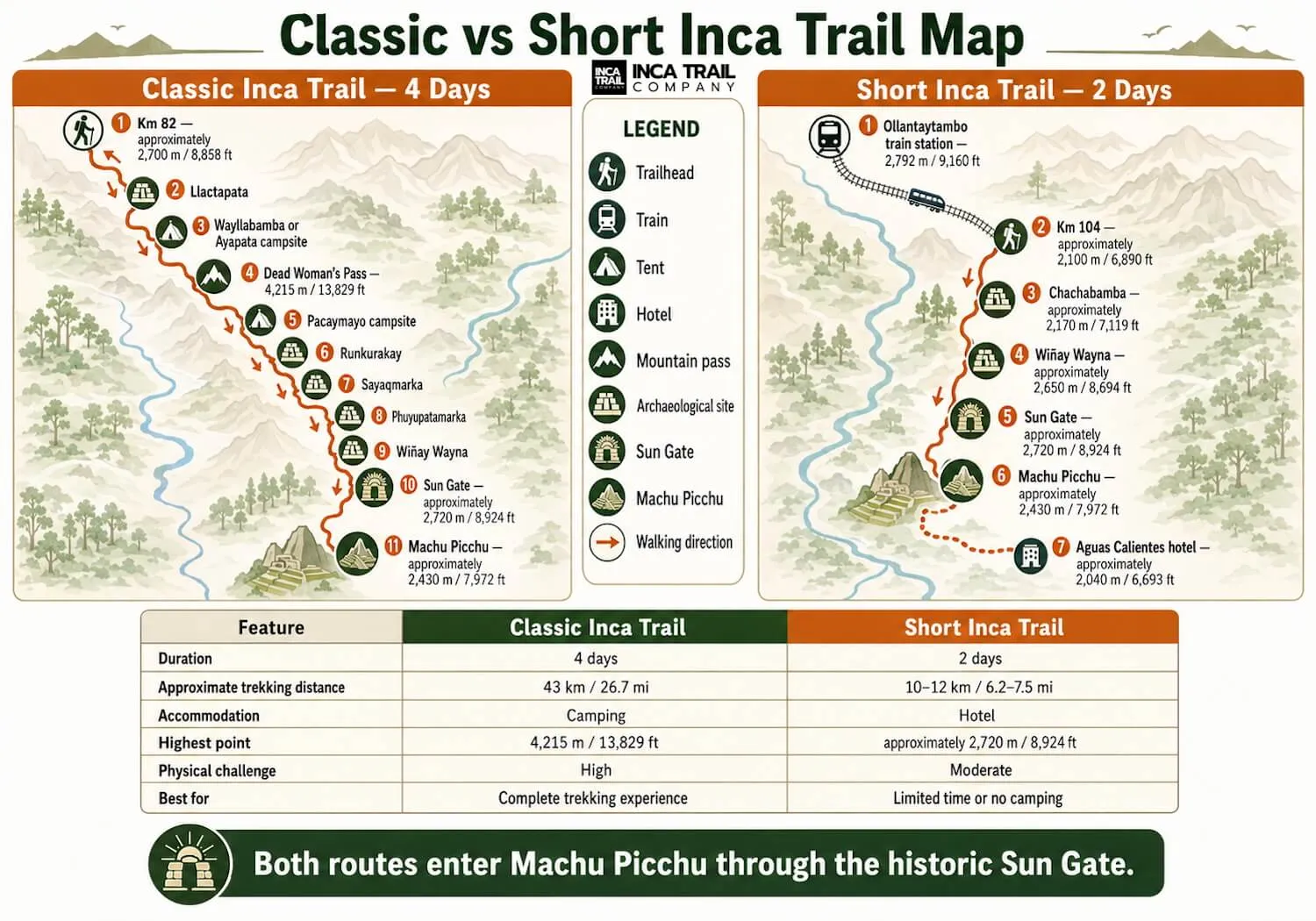
Map comparing the Classic Inca Trail from Km 82 with the Short Inca Trail from Km 104 to Machu Picchu
Planning comparison of the two regulated access routes. It is not an independent-navigation map.
Route 5 · Km 104

Choose the 2-day route if…

You want to arrive on foot without building the entire Peru trip around a four-day expedition.

  1. 01

    Your Peru itinerary is tight

    One full trail day preserves time for Cusco, the Sacred Valley or another region.

  2. 02

    A hotel improves the experience

    Most two-day formats sleep in Aguas Calientes, with a bed and shower before the guided Machu Picchu visit.

  3. 03

    You want a shorter physical test

    The route avoids the Classic Trail’s highest passes and accumulated four-day fatigue, though its main climb remains substantial.

  4. 04

    Inti Punku is the priority

    You still reach the Machu Picchu area through the Sun Gate and visit Wiñay Wayna on foot.

  5. 05

    Fitness levels are mixed

    It can suit active families, older travelers and first-time trekkers when mobility and stair tolerance are appropriate.

Explore the 2-day route
Route 1 · Km 82

Choose the 4-day route if…

You want the broader historic route to matter as much as the final destination.

  1. 01

    The trail itself is the goal

    The longer route creates a multi-day journey rather than a single-day approach to Machu Picchu.

  2. 02

    You enjoy trekking and camping

    Three nights on the route provide immersion, supported by guides, cooks and porter teams.

  3. 03

    Archaeology matters

    The route connects Patallacta, Runkurakay, Sayaqmarca, Phuyupatamarca, Intipata and the shared final corridor.

  4. 04

    You want changing landscapes

    Agricultural valleys, exposed passes, high Andean terrain and cloud forest unfold over several days.

  5. 05

    You are prepared for altitude

    The climb to Dead Woman’s Pass and long stone descents demand acclimatization and route-specific training.

Explore the 4-day route

Which is harder?

The Classic route, by a wide margin

The four-day trek covers more distance, climbs much higher and asks tired legs to repeat the effort. The short route avoids the main passes and accumulated fatigue, but its one trail day still contains a sustained cloud-forest ascent and steep stone steps.

See the full difficulty analysis
2-day challenge
One concentrated climbing day
4-day challenge
Altitude plus repeated effort
Highest Classic point
4,215 m / 13,829 ft
Shared terrain
Uneven paving and stone stairs

Hotel versus camping

Accommodation can decide the route before distance does

2 days

Aguas Calientes hotel

Most packages leave the regulated trail after the principal hiking day and use a hotel before the next day’s Machu Picchu visit. You gain a bed, shower and conventional indoor space.

Some companies offer camping versions, so “2-day” alone does not confirm accommodation.

4 days

Three controlled camps

You remain inside the journey and wake ready for the next stage. Comfort depends on tents, sleeping system, weather, campsite allocation and the operator’s logistics.

Immersion is the advantage; basic facilities and three nights outdoors are the cost.

What both routes share

The final archaeological corridor

  • Cloud-forest terrain
  • Wiñay Wayna
  • Inti Punku, the Sun Gate
  • An approach toward Machu Picchu on foot

What the Classic route adds

Passes, sites and progression

  • Patallacta and Wayllabamba
  • Dead Woman’s Pass
  • Runkurakay and Sayaqmarca
  • Phuyupatamarca and Intipata
  • Several ecological transitions

Cost comparison

Two days is usually cheaper—not half price

The Short Trail still requires regulated access, admission, trains, transfers, a guide, bus transport and normally a hotel. The Classic route adds cooks, porter teams, camp equipment, meals and several operating days.

Understand every cost component

Compare the final package

  • Exact trail and Machu Picchu admission
  • Hotel category or tent capacity
  • Train, buses and final transfers
  • Porter allowance and equipment rentals
  • Meals, water and group size
  • Payment and cancellation terms
Compare operators

Separate inventory

Route 1 can be sold out while Route 5 remains open

The two options use different official access routes and availability categories. A company cannot transfer a Classic permit into a Short permit or bypass official inventory.

Compare live calendars

If the Classic route is unavailable

  1. Check neighboring start dates.
  2. Check Route 5 separately.
  3. Confirm Machu Picchu arrangements.
  4. Compare alternatives only after checking flexibility.

The Short Trail is a genuine route with its own strengths, not merely a consolation prize.

A five-question decision

Your honest answers usually reveal the route

  1. 01

    How much time do you have?

    Choose two days to protect time for other destinations. Choose four when the trek is a principal reason for visiting Peru.

  2. 02

    How important is comfort?

    Choose the hotel format when sleep and a shower materially improve the trip. Choose camping when camp life is part of the appeal.

  3. 03

    Which challenge do you want?

    Choose one sustained hiking day or a four-day endurance test reaching approximately 4,215 meters.

  4. 04

    What would you regret missing?

    Would you regret missing most of the Classic Trail—or regret committing four days to camping and hard hiking?

  5. 05

    Which permit exists?

    Check both regulated routes for the actual start date before reorganizing flights, hotels or the wider Peru itinerary.

2 days

Reach Machu Picchu on foot

Best when time, comfort and a manageable single-day challenge matter most.

View the Short Trail guide →
4 days

Make the trail the journey

Best when archaeology, landscape, challenge and expedition atmosphere matter most.

View the Classic Trail guide →

Quick answers

2-day vs 4-day FAQs

Schedules and access conditions can change; confirm the actual operator itinerary and tickets.

Is the 2-day or 4-day Inca Trail better?

The two-day route is better for limited time, hotel comfort and a shorter challenge. The four-day route is better for the complete trekking journey, high passes, more archaeological sites and three nights of camping.

Is the 2-day Inca Trail worth doing?

Yes. It follows the official Chachabamba–Wiñay Wayna–Inti Punku corridor and reaches the Machu Picchu area on foot. It omits most of the Classic route, but retains one of its most important final sections.

Do you hike for two full days on the 2-day route?

Usually not. Most commercial two-day itineraries contain one principal hiking day from Km 104 and a separate guided Machu Picchu visit the next day.

How much harder is the 4-day route?

It is considerably harder overall because it covers much more terrain, reaches 4,215 meters and repeats substantial effort across four days. The short route still has a sustained climb and many stairs.

Do both routes use the Sun Gate?

Both normally approach the Machu Picchu area through Inti Punku. Short-route hikers commonly arrive in the afternoon; Classic groups usually arrive early on their final morning. Actual timing and visitor arrangements can vary.

Do you camp on the 2-day Inca Trail?

Most packages use an Aguas Calientes hotel, but camping versions exist. Confirm the accommodation because “2-day Inca Trail” does not describe one universal package.

What do you miss on the short route?

You miss the Classic route’s first and middle sections, high passes, several archaeological sites, ecological transitions and three-night expedition. You retain Chachabamba, Wiñay Wayna and Inti Punku.

Why is the 2-day route still expensive?

It still needs regulated access, Machu Picchu admission, trains, transfers, a guide, buses and often a hotel. Those fixed costs explain why it is not normally half the four-day price.

Which route is better for first-time trekkers?

The two-day route is generally more manageable. A prepared beginner can complete the Classic route, but should train for hills, stairs, long descents and consecutive days while acclimatizing in Cusco.

Do the routes use the same permit?

No. The Classic and Short Trails use separate official routes and inventory categories. Availability for Route 1 does not guarantee availability for Route 5, or vice versa.

Sources and distance methodology

Official corridor lengths, access points and route categories come from SERNANP. Wider practical ranges reflect common itinerary and GPS definitions; they are labeled separately so businesses and travelers do not repeat figures without their endpoints.

This comparison evaluates route formats, not a specific operator’s package. Camps, hotel, timing and Machu Picchu visit arrangements must be checked for the actual booking.

Reviewed August 5, 2026 · Corrections: contact our editorial team

Ready to choose?

Compare Route 1 and Route 5 on your date

The practical choice begins with your priorities and ends with real permit inventory.

Check both routesSee the route map