Male legal maximum
Total assigned load, not a customer luggage allowance.

Professional work, legal rights and traveler choices
Understand who carries the expedition, what the law requires and how to distinguish a written labor policy from an ethical marketing claim.
Porters are not a charitable feature of an Inca Trail package. They are professional trekking workers with enforceable protections.
Wages, food, equipment, insurance, safe loads and overnight protection are operator responsibilities. A generous tip cannot correct a business model that underfunds them.
This is a traveler-focused explanation of Peruvian legislation, not legal advice. Operators and workers should obtain current professional guidance for compliance or disputes.
Five facts before comparing tours
Total assigned load, not a customer luggage allowance.
The law explicitly establishes the lower maximum.
S/165 per daily working period using the 2026 UIT of S/5,500.
Under the 2024 amendment, with overtime and weekly-rest rules.
Customary, but never a substitute for statutory remuneration.
A mobile expedition team
There are no vehicle-accessible hotels between the Classic route’s designated camps. Tents, food, kitchen equipment, safety supplies and waste systems must move through high-altitude terrain by human effort.
Porters often finish packing after trekkers leave and then reach the next stop early enough to rebuild camp. Respect that skill without romanticizing physical strain as “superhuman.”
Transports an assigned share of communal equipment and supplies.
Carries an agreed allowance of a traveler’s overnight belongings between camps.
Coordinates the porter team, load distribution and timing.
Plans and prepares food and manages the mobile camp kitchen.
Leads travelers, interprets the route and manages the trek; it is a separate professional role.

Three numbers travelers confuse
Ask whether the sleeping bag, mat, duffel and the porter’s own clothing and sleeping equipment are included in each calculation.
A personal porter does not walk beside you
Overnight luggage normally moves between camps with the support team. You may not see it again until the day’s destination.
Open the packing checklistLegal minimums are not optional benefits
Law 31614 established the New Porter Worker Law in 2022. Law 32137 changed Articles 4, 5 and 10 in October 2024; summaries repeating the original version without the amendment may now be outdated.
Maximum 20 kg for men and 15 kg for women; supervised by the competent labor-inspection authority.
Nutritious food, suitable clothing, personal protective equipment, lumbar and sun protection, and overnight gear.
Suitable covered spaces that protect life and health from weather and natural events.
Complementary risk-work insurance, life insurance and occupational safety measures for the activity.
At least 3% of the annual UIT for each daily working period; a porter performing cooking duties receives an additional 30%.
The 2024 amendment sets a maximum of 48 hours per week for the specific expedition, with overtime rules and mandatory weekly rest.
No hiring under age 18; equal opportunity, nondiscrimination and collective labor rights apply.
Assign responsibility correctly
Authorization is only the first check
“Our porters are family” is not evidence. Ask for measurable policies before the deposit becomes nonrefundable.
Customary, voluntary and separate from pay
There is no official Inca Trail gratuity tariff. Operator suggestions vary because team size, roles, duration and group size vary. A universal dollar amount would create false precision.
Should you hire a personal porter?
The service can help travelers protect knees or backs and those less experienced with multi-day packs. It does not reduce altitude, stairs or consecutive hiking days.
Arrange it during booking or before the company deadline. Additional staffing and load capacity cannot be assumed at the trail entrance.
Review the 12-week training plan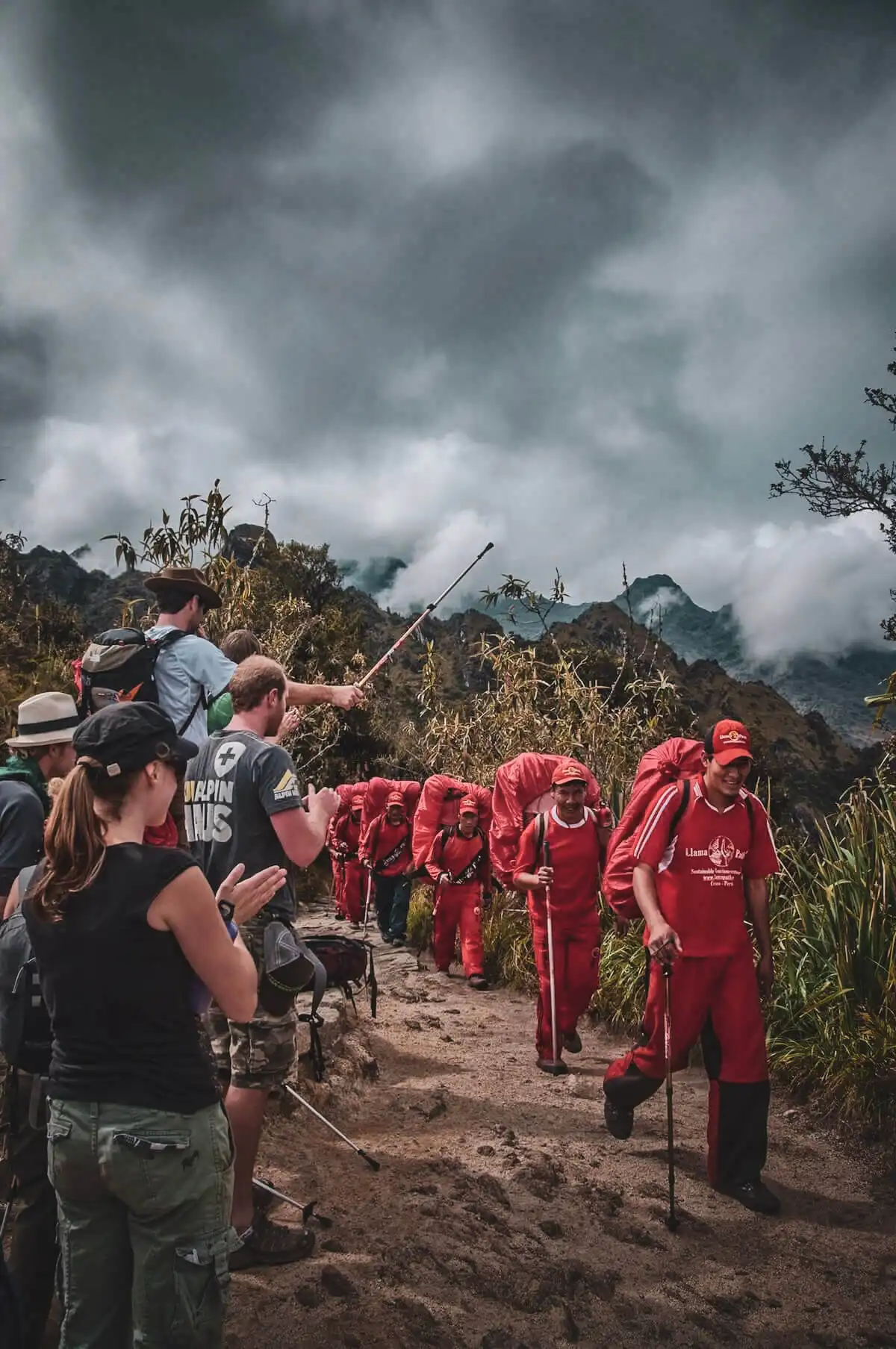
Professional respect on the trail
Female porters are professionals, not a novelty
Ask whether women receive regular departures, equipment in appropriate sizes, safe and private sleeping arrangements, equal pay under the statutory formula and paths into head-porter, cooking or guiding roles.
A promotional departure or photograph does not establish a long-term employment policy. Always request consent before an individual portrait.

Quick answers
They transport communal tents, food, kitchen and dining equipment, safety supplies and, when arranged, a stated allowance of travelers’ overnight belongings between camps.
Law 31614 sets maximum loads of 20 kg for male porters and 15 kg for female porters. Ask whether the operator’s calculation includes the worker’s own clothing and sleeping equipment.
No. Your duffel allowance is a package limit. The legal maximum applies to a porter’s complete load, which can combine communal equipment, customer luggage and other assigned items.
Not every traveler does, but the service can reduce strain on knees or back. You still carry water, rainwear, medication, documents, valuables and any layer needed before camp.
There is no official mandatory amount. Ask for the company’s current role-based or group-pool guidance, confirm the team size and distribution, and decide voluntarily before the final gathering.
Legal remuneration, food, equipment, insurance and required working conditions are operator responsibilities and should be funded by the tour price. Tips are separate and cannot replace them.
Look for accurate load limits, written policies, specific equipment and sleeping standards, insurance details, transparent remuneration and a complaint process—not only testimonials or family language.
Yes, women work in porter teams. The law sets a 15 kg maximum load for female porters and applies the same protections concerning pay, equipment, accommodation, safety and nondiscrimination.
Stay within the luggage allowance, give loaded workers room to pass, ask before taking portraits, keep tips separate from labor rights and choose the operator before paying based on verifiable practices.
Legal figures are taken from official texts. Operator practices, customer allowances and tipping methods vary and should be confirmed in the current booking documents.
When legislation and older tourism articles conflict, this page gives priority to the enacted law and its later amendment.
Legal review: August 5, 2026 · Corrections: contact our editorial team
Reward transparent operations
Check dates first, then evaluate loads, equipment, food, insurance and pay before choosing the operator.