
A protected habitat—not a scheduled wildlife show
Inca Trail wildlife
The trail crosses rock, grassland, river corridors and humid mountain forest. Learn where to look, what may appear and which famous animals remain genuinely rare.

Look for movement, not a checklist.
The biodiversity is real; every sighting remains uncertain
SERNANP documents exceptional diversity across the entire 32,592-hectare sanctuary. Those totals include habitats far beyond the visitor’s immediate line of sight and should not be converted into animals promised on one trek.
Small birds, butterflies and occasional rocky-slope sightings are more realistic than a spectacled bear, condor or large predator.
Set realistic expectationsSanctuary-wide biodiversity
Official totals need a geographic label
These are SERNANP figures for the Historic Sanctuary of Machupicchu—not a prediction for the Classic Trail, Short Trail or one departure date.
Expectation ladder
Existence, habitat and visibility are different
These categories are practical editorial guidance—not scientific abundance estimates.
Possible in suitable habitat—not promised
Worth actively looking for
- Hummingbirds around flowers and forest edges
- Tanagers, parakeets and other small birds
- Butterflies in warm or sunny openings
- Vizcachas around quiet rocky terrain
- Raptors or caracara-like birds over open slopes
Sound, distance and vegetation matter
Possible, easy to miss
- Mountain toucans in humid forest canopy
- Torrent ducks near suitable fast-flowing water
- Andean guans and other forest birds
- Deer in quieter mountain or forest habitat
- Amphibians and reptiles at close scale
Presence in the sanctuary ≠ likely trek sighting
Treat as exceptional
- Spectacled bear
- Andean cock-of-the-rock
- Confirmed Andean condor
- Any elusive large predator
- A clear view of every species on a checklist
Classic Trail · habitat order
Change your search as the landscape changes
A species list is less useful than learning where to direct your eyes and ears.
Vegetation · farms · river corridor
Lower valleys
Start listening before the high trail. Watch flowering plants, woodland edges and movement along the Cusichaca and Urubamba landscape.
Rock · grassland · open sky
High Andean terrain
Near the passes, scan rocky slopes for small mammals and broad sky for raptors. Dense-forest species are not the target here.
Moisture · shrubs · mixed cover
Ecological transition
Around Paqaymayu and the later high trail, changing vegetation matters more than one named viewpoint. Pause where habitat structure changes.
Canopy · flowers · streams · calls
Montane cloud forest
Toward Phuyupatamarka and Wiñay Wayna, watch forest gaps and listen for birds hidden by dense vegetation.
Forest surrounding archaeology
Final sanctuary corridor
Intipunku and Machu Picchu remain inside a natural setting. Llamas around the llaqta are not the same as wild trail mammals.
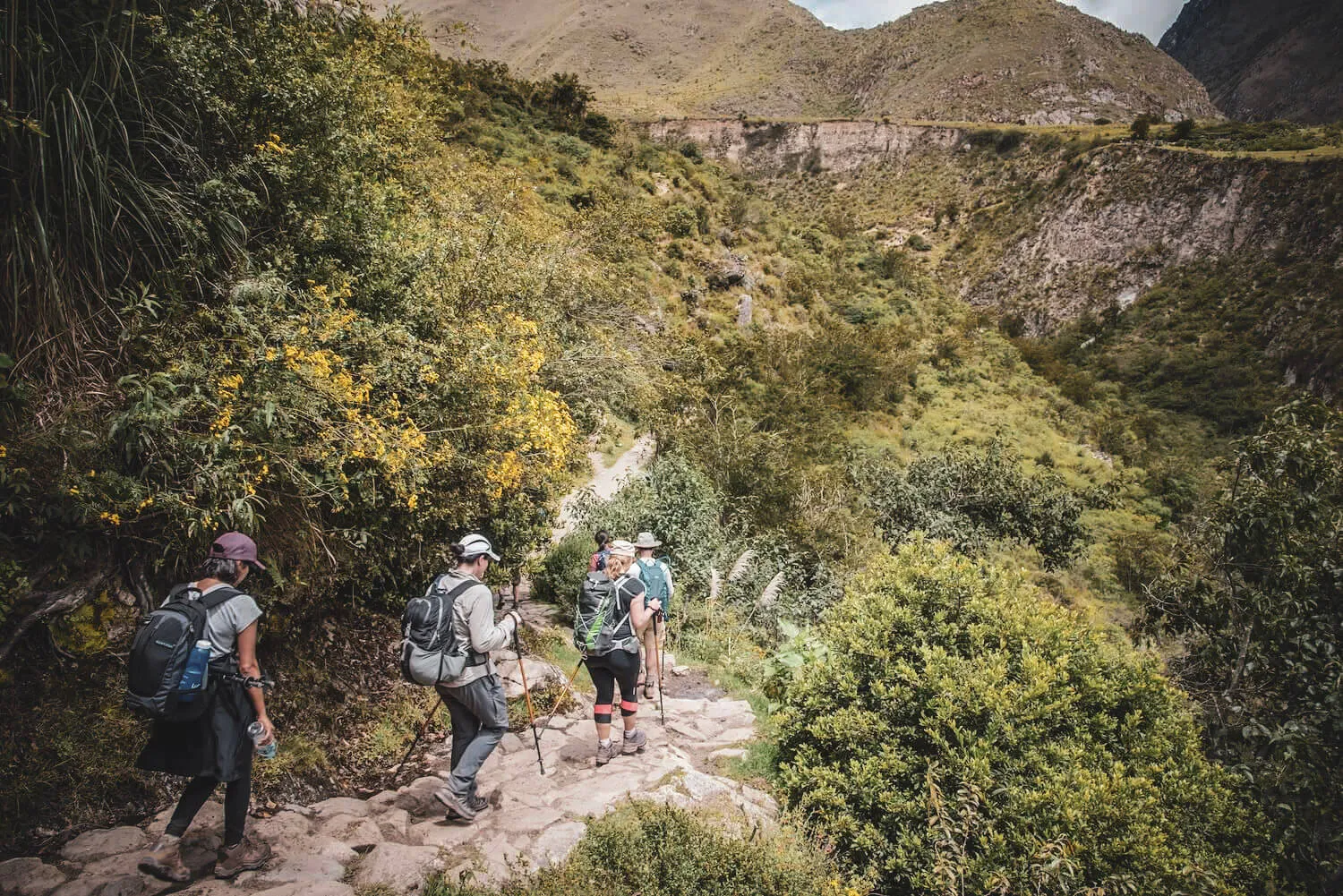
The route’s ecological argument
High Andes gives way to cloud forest
Open slopes reward wide scanning. Forest rewards patience at close range: canopy movement, calls, flowers, damp stone, streams and short gaps between trees.
UNESCO identifies the sanctuary’s position between the Andes and upper Amazon basin as central to its natural value. The visitor experiences that relationship as a transition, not a boundary line painted across the trail.
The most productive wildlife layer
Birds reward habitat-specific attention
SERNANP names hummingbirds, toucans, tanagers, parakeets, cock-of-the-rocks and torrent ducks within the sanctuary context.
Hummingbirds
Flower-rich vegetation and forest edgesSize and flight style vary. Stop at flowers instead of trying to follow one moving bird through vegetation.
Tanagers and parakeets
Canopy, forest edge and crossing gapsColor may appear only briefly. Calls and group movement can reveal birds before a clear view.
Mountain toucans
Humid montane forestLook upward into canopy and exposed branches. A listed bird group is not a daily guarantee.
Torrent ducks
Clear, fast-moving mountain waterHabitat is specific. Scan suitable river stretches rather than expecting them beside every stream.
Cock-of-the-rock
Humid Andean forestThe species occurs in the sanctuary, but a trail encounter should be treated as uncommon and fortunate.
Large soaring birds
Open high terrain and mountain skyDo not label every distant silhouette a condor. Ask the guide and retain uncertainty when field marks are missing.
Mammals without marketing inflation
The bear is present—and still rare to see
SERNANP lists spectacled bears, vizcachas, deer, bats and rodents among sanctuary mammals. That supports presence, not a promise of visibility from the regulated trail.
Ask operators about naturalist guidingVizcacha
Pause around quiet rock and stone. Its coloring can disappear into the background until ears or movement reveal it.
Deer
Quieter habitat and chance matter. Do not compare wild deer with the much more visible llamas at Machu Picchu.
Spectacled bear
Remain distant, quiet and out of its route. Never approach, surround or bait a bear for a photograph.
Large predator
Do not design the trek around a puma or repeat wider-Andes presence as though it were a likely trail sighting.
Flora is not background decoration
Orchids and forest structure shape what can live here
SERNANP records 332 tree species and several orchid genera across the sanctuary. Flowering and visibility vary by place and time.
Look; do not collect
Small flowers can be easier to miss than large animals. Stay on route and never move vegetation to stage a photograph.
Search in layers
Ground, understory, branches and open canopy gaps support different observation opportunities.
Notice transition
High-elevation plant communities are part of the habitat mosaic, not merely the empty space before cloud forest.
Expect epiphytes and close detail
Moss, bromeliad-like forms, orchids and damp surfaces become more prominent in humid sections.
A six-part observation routine
Slow down without disrupting the itinerary
Wildlife interest should be communicated before the trek. A guide cannot redesign regulated timing at every sighting, but can help identify good habitats and prevent confident misidentification.
Add compact optics to the packing list- 01Tell the guide before departure that birds or wildlife are a priority.
- 02Walk quietly and pause to listen instead of speaking continuously.
- 03Scan rock, sky, canopy, flowers and water—not only the stones underfoot.
- 04Use compact binoculars or a zoom lens rather than moving closer.
- 05Keep the daypack organized so observation does not delay narrow trail sections.
- 06Record an uncertain species as uncertain until identifying features are checked.
Leave behavior unchanged
Responsible wildlife watching
SERNANP asks visitors to use marked routes and respect fauna, flora and landscape. A rare sighting is never an exemption.
Never feed
Food changes animal behavior and can create harmful associations with visitors.
Never chase
A photograph is not worth changing an animal’s route, feeding or resting behavior.
Stay marked
A sighting does not authorize leaving the protected visitor path or entering vegetation.
Keep distance
Let the animal choose whether the encounter continues. Use optics instead of approach.
Do not handle
Reptiles, amphibians, insects, feathers, nests and plants should remain where they are.
Share quietly
Point and speak softly so other visitors can observe without surrounding the animal.
No universal best wildlife month
Season changes conditions—not certainty
April through October is SERNANP’s recommended visiting season, while November through March is rainier. Clearer hiking conditions can help scanning; wetter conditions can intensify vegetation and reduce visibility.
Noise, timing, flowering, weather and luck may matter more to one sighting than the season label.
Compare month-by-month trade-offs- Clearer views
- Can help open-slope scanning
- Rain and cloud
- Can limit distance and reveal close detail
- Early trail hours
- Can be quieter and easier for listening
- Guarantee?
- Never
Image integrity
We will not turn a stock animal into a trail sighting
This guide uses habitat imagery rather than unverified species photographs. It does not imply that a generic bear, condor or toucan image was captured on this route.
Choose the habitat range
Classic and Short routes offer different ecological depth
The Classic Trail crosses the broader elevation and habitat progression. The Short Trail concentrates on the humid final corridor. Availability is a planning signal, not a wildlife forecast.
Understand permit availability Permit checker
Find a departure
Checking availability
Please wait while we check the selected date.
Nearby options
Dates in the same month currently showing permits
Availability data may be delayed. It does not guarantee a permit, tour departure or confirmed booking.
Direct answers
Inca Trail wildlife FAQs
Possible means possible—not included in the itinerary.
What animals can you see on the Inca Trail?
Hikers can look for hummingbirds, tanagers, other forest birds, butterflies and vizcachas. Toucans, torrent ducks, deer and many other animals are possible in suitable habitat but easy to miss.
Are there spectacled bears in the Machu Picchu sanctuary?
Yes. SERNANP includes the spectacled bear among the sanctuary’s fauna. Seeing one on a standard trek is rare and should never be promised by a guide or operator.
Can you see Andean condors?
A large soaring bird is possible in the Andes, but the Inca Trail is not a dependable condor-viewing itinerary. Identification at distance is difficult, so do not assume every silhouette is a condor.
Are there pumas on the trail?
Large predators may occur in the wider Andes, but a puma is not part of the practical visitor wildlife list published by SERNANP for these routes. Treat an encounter as exceptional rather than an expectation.
Where is the best wildlife section?
There is no single best point because the habitat changes. Open high terrain favors scanning rock and sky; the later cloud-forest corridor favors canopy birds, hummingbirds, butterflies and close observation.
What is the best time of day?
Quieter early periods can help because birds are easier to hear and trail traffic may be lower. The regulated itinerary determines how long a group can stop.
What is the best season?
No season guarantees sightings. April through October is SERNANP’s recommended sanctuary visiting season, while November through March is rainier. Those are travel-condition labels, not wildlife promises.
Do I need binoculars?
No, but compact binoculars materially improve bird observation and allow you to keep a responsible distance.
Are the llamas at Machu Picchu wild?
No. Llamas visible around Machu Picchu should not be counted as a wild mammal encounter on the trail.
Is the Inca Trail a wildlife trip?
Wildlife is an important layer of the protected landscape, but the trek combines walking, archaeology, scenery and regulated logistics. It is not a safari with scheduled animal appearances.
Sources and expectation policy
SERNANP owns the sanctuary-wide counts, named fauna groups, visitor activities and conduct guidance. UNESCO supports the mixed cultural-natural landscape context. Sighting likelihood is conservative editorial guidance, not an abundance survey.
Reviewed August 9, 2026 · Corrections or verified images: contact our editorial team
The most useful wildlife skill is attention
Listen before you decide the forest is empty
Choose the route, tell the guide your priorities and leave every animal behaving as it was.