
High elevation
The route starts above 2,600 meters and reaches 4,215 meters. The same climb generally feels slower and more demanding here than near sea level.

An honest physical assessment
The Classic 4-Day Inca Trail is strenuous but non-technical. Its real challenge is climbing and descending uneven stone steps at high elevation, then repeating the effort over four consecutive days.
You do not need climbing experience or exceptional athletic ability.
You do need enough endurance and leg strength to walk for several hours, manage a major mountain ascent and continue hiking when your legs are already tired.
This guide covers physical effort, elevation and terrain. Use our altitude sickness guide for acclimatization and symptoms, and our safety guide for hazards and emergency planning.
Difficulty at a glance
Daily mileage looks moderate until elevation, irregular steps and accumulated fatigue are added.
Daily distances vary with campsite allocation, archaeological-site detours and GPS measurement. Use these figures as planning estimates, not guaranteed itinerary measurements.
How hard is the Inca Trail?
Calling the trail “moderate” can be misleading. Averaging roughly 10 or 11 kilometers per day sounds comfortable until that distance includes a climb to 4,215 meters, long staircases and repeated descents on legs that have not fully recovered.
The most useful description is a strenuous high-elevation hike rather than a technical mountain climb.
A regular hill walker who trains on steep terrain will probably find it demanding but manageable. Someone who exercises frequently but only on flat ground may be surprised by how quickly the steps fatigue the legs.
What makes it hard?
No ropes, harnesses or mountaineering skills are required. The challenge is maintaining controlled movement for hours across steep, uneven terrain.
The route starts above 2,600 meters and reaches 4,215 meters. The same climb generally feels slower and more demanding here than near sea level.
Stone steps change in height, depth and angle. They interrupt a natural stride and make every ascent and descent less predictable.
Day 3 begins after the trail’s largest climb and a steep descent. The route tests recovery and repeatability, not only one day of fitness.
Route profile
The climb to Dead Woman’s Pass is the highest and most demanding ascent; the longest sustained descent comes later, when the legs are already fatigued.
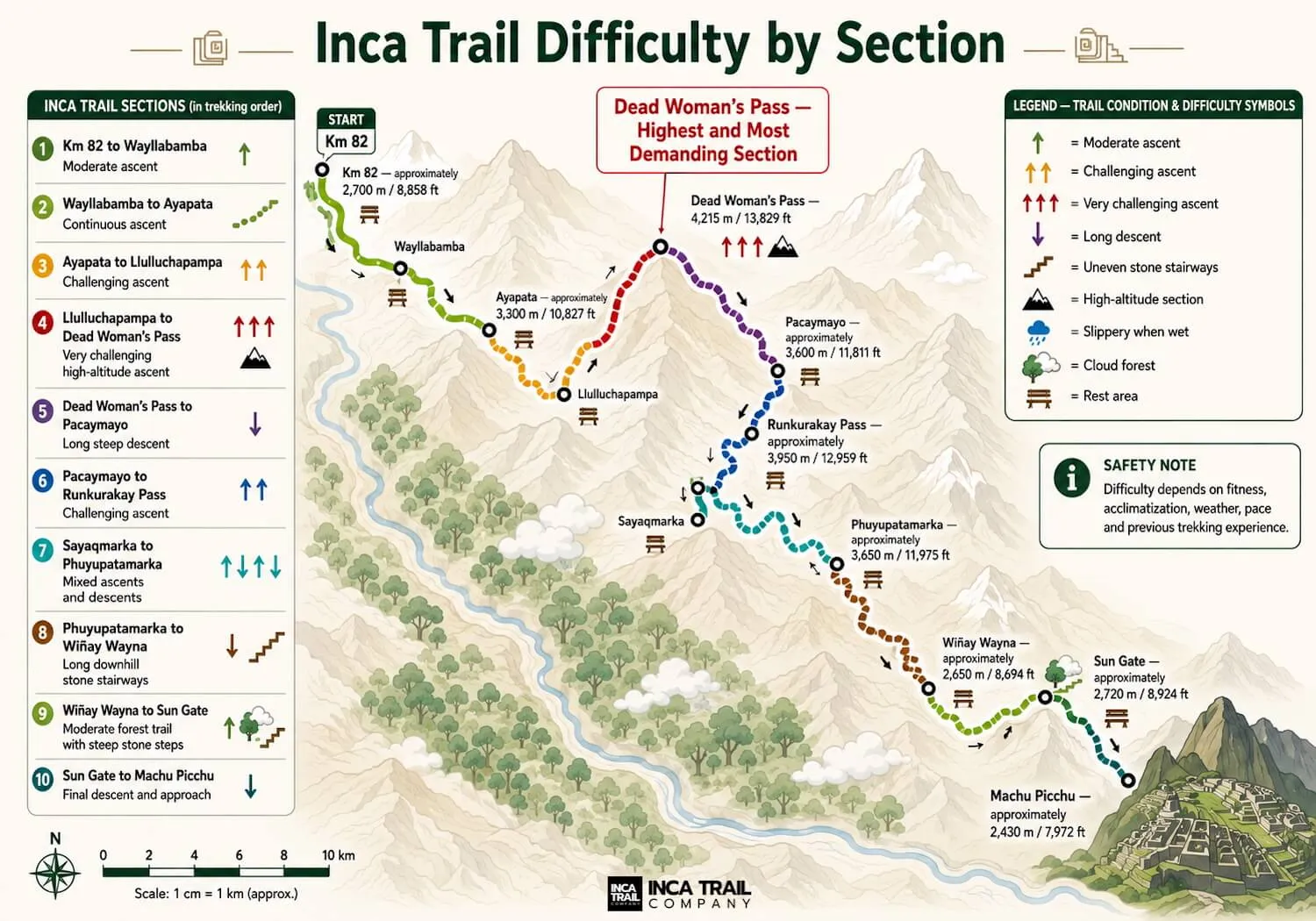
Day-by-day metrics
This profile uses a common schedule with camps near Wayllabamba, Pacaymayo and Wiñay Wayna.
| Day and route | Distance | Start | Highest point | Finish | Ascent | Descent | Time | Effort |
|---|---|---|---|---|---|---|---|---|
| Day 1Km 82 → Wayllabamba | 12 km / 7.5 mi | 2,680 m | 3,100 m | 3,010 m | 430 m | 100 m | 5–6 hr | Moderate |
| Day 2Wayllabamba → Dead Woman’s Pass → Pacaymayo | 11 km / 6.8 mi | 3,010 m | 4,215 m | 3,600 m | 1,180 m | 615 m | 7–8 hr | Strenuous |
| Day 3Pacaymayo → Wiñay Wayna | 16 km / 9.9 mi | 3,600 m | 3,970 m | 2,650 m | 450 m | 1,400 m | 8–10 hr | Hard on the legs |
| Day 4Wiñay Wayna → Machu Picchu | 5 km / 3.1 mi | 2,650 m | 2,720 m | 2,450 m | 90 m | 290 m | 2–3 hr | Easy to moderate |
Reference totals: approximately 42–46 km / 26–29 mi across four hiking days, with roughly 2,150 m / 7,050 ft of cumulative ascent in this common profile. Different campsite schedules and measurement methods produce different totals.
What it feels like: A long warm-up that gradually becomes a real mountain hike.
The route starts around Km 82 at approximately 2,680 meters. Its opening kilometers are comparatively gentle, giving hikers time to establish a sustainable rhythm before the elevation gain becomes more consistent.
The final climb toward camp is where many travelers first notice the weight of a daypack and the difference between everyday fitness and trekking fitness. Moving too quickly because the first section feels manageable is the common mistake; conserving energy matters more than reaching camp early.
Do not use Day 1 as proof that the rest of the route will be easy. Day 2 reaches a point more than 1,000 vertical meters above many first-night camps.
What it feels like: A continuous staircase climb followed by a substantial descent.
Day 2 normally demands the greatest cardiovascular effort. From the Wayllabamba area, the trail climbs through Llulluchapampa toward Warmiwañusqa, or Dead Woman’s Pass, at 4,215 meters.
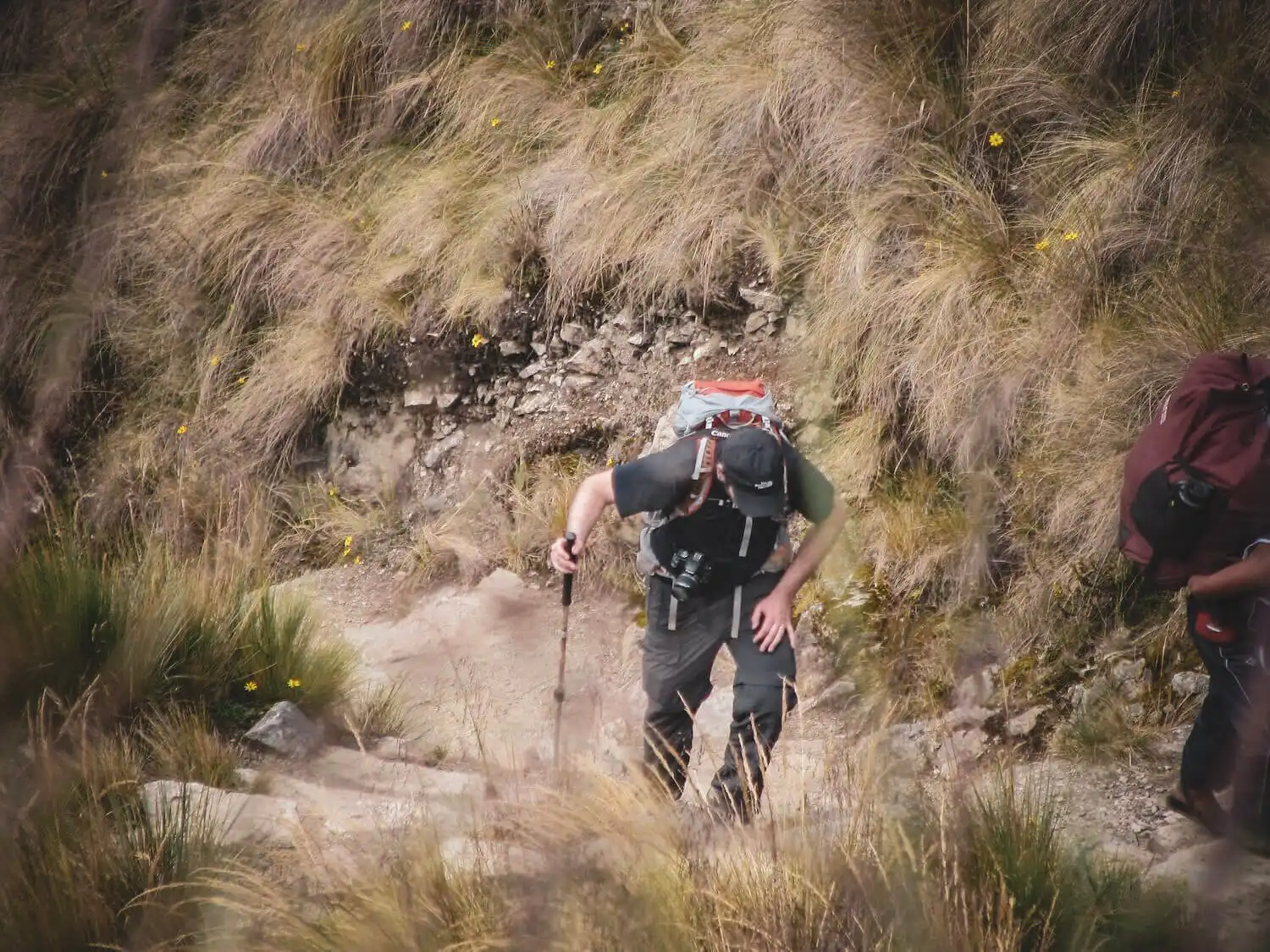
Under this common schedule, the day includes approximately 1,180 meters of ascent. Step height and gradient change repeatedly, so hikers cannot rely on one mechanical rhythm. As the pass gets closer, a normal pace often becomes small groups of steps separated by short pauses.
The work does not finish at the pass. Tired quadriceps must immediately change from lifting the body uphill to controlling roughly 600 meters of steep descent toward Pacaymayo. Some campsite schedules continue farther, making this an even longer day.
What it feels like: Easier breathing than Day 2, but hours of controlled foot placement.
Day 3 may contain less cumulative climbing than Day 2, but that does not make it easy. In this profile, hikers cover approximately 16 kilometers and descend about 1,400 meters before reaching Wiñay Wayna.
Much of that loss in elevation occurs on stone stairs. The quadriceps work eccentrically—as brakes—to stop the body accelerating from one irregular step to the next. That repeated loading explains why hikers with good cardio can still find Day 3 harder on their legs than the major climb.
Archaeological sites and short flatter sections break up the descent, but they do not eliminate its accumulated effect. Training only for uphill fitness leaves a major gap in preparation.
What it feels like: One steep surprise followed by a final descent on fatigued legs.
Day 4 is normally the shortest and physically easiest stage. From Wiñay Wayna, the principal trail section to Inti Punku, the Sun Gate, commonly takes around an hour before the route descends toward Machu Picchu.
The famous final staircase before the Sun Gate is short but unusually steep; some hikers use their hands for balance. It is not technical climbing, yet it can feel serious after three consecutive days of exertion.
Once past this section, the route trends downhill. Sore quadriceps, hip flexors or knees can still make the last approach feel less effortless than its distance suggests.
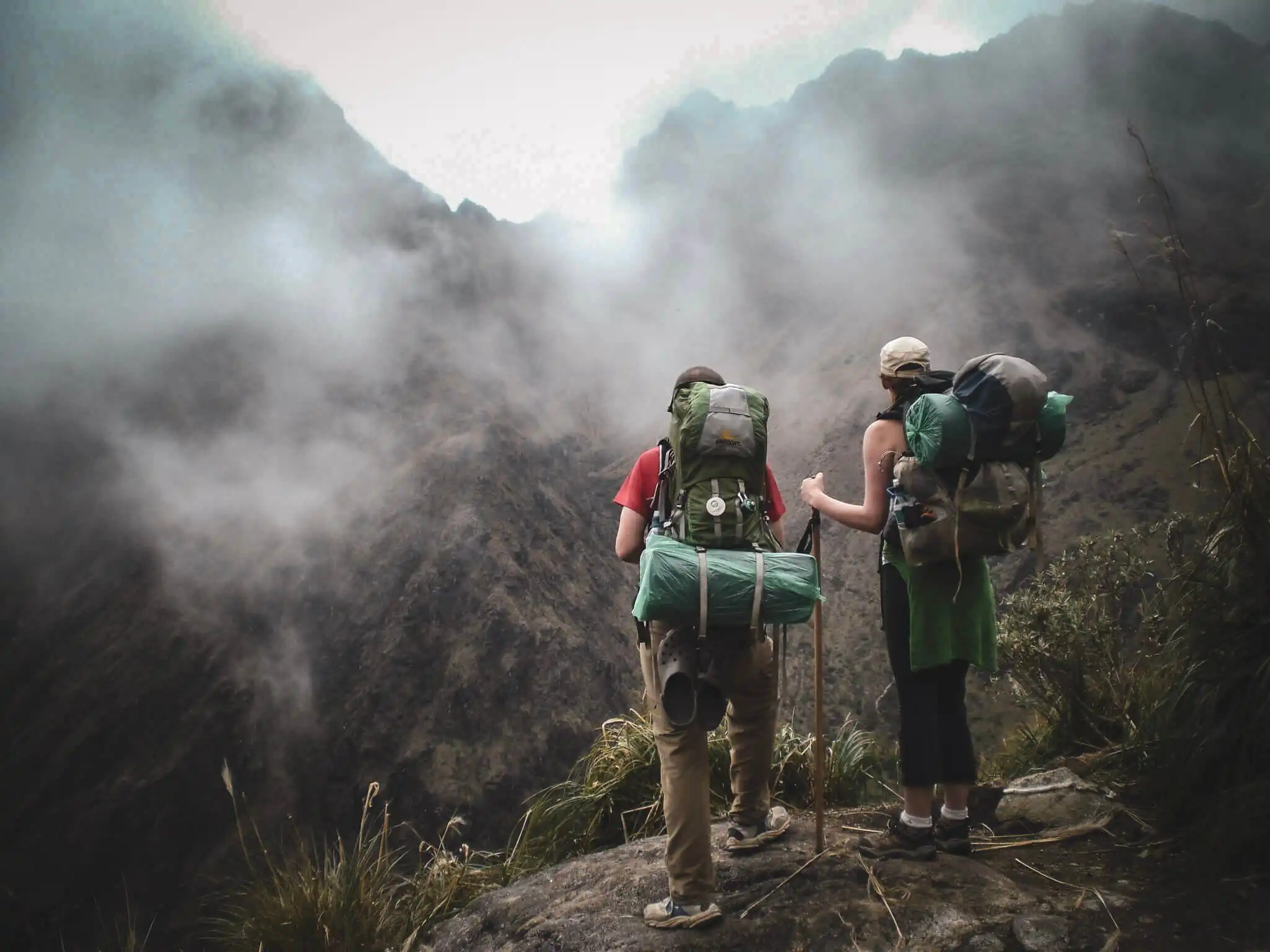
Why the stairs matter
Irregular steps repeatedly break a natural rhythm. A high step needs more force; a narrow or angled one needs more careful placement. A StairMaster is useful training, but its uniform steps cannot reproduce that variation.
Descending is not passive recovery. The quadriceps repeatedly control the body as it drops from step to step. Research on downhill walking supports what guides observe on the trail: specific downhill preparation can reduce the muscular damage and soreness caused by a long descent.
Read the downhill-walking studyFour consecutive days
Many active travelers can complete a difficult day hike. The more relevant question is whether they can wake up and continue for another six to ten hours while the previous day is still present in their legs.
Introduces sustained walking, elevation and the loaded daypack.
Produces the route’s largest uphill effort and an immediate steep descent.
Loads already tired legs with the longest day and greatest descent.
Requires a final steep push before the approach to Machu Picchu.
The highest point
Warmiwañusqa is normally reached on Day 2 after the route climbs progressively through forest and more exposed terrain. Near the pass, a normal walking pace often becomes a short group of steps, a brief pause, controlled breaths and another slow push.
Reaching the pass is a major milestone, not the end of the day. The route still descends hundreds of vertical meters on steep stone steps toward Pacaymayo.
Explore the complete pass guide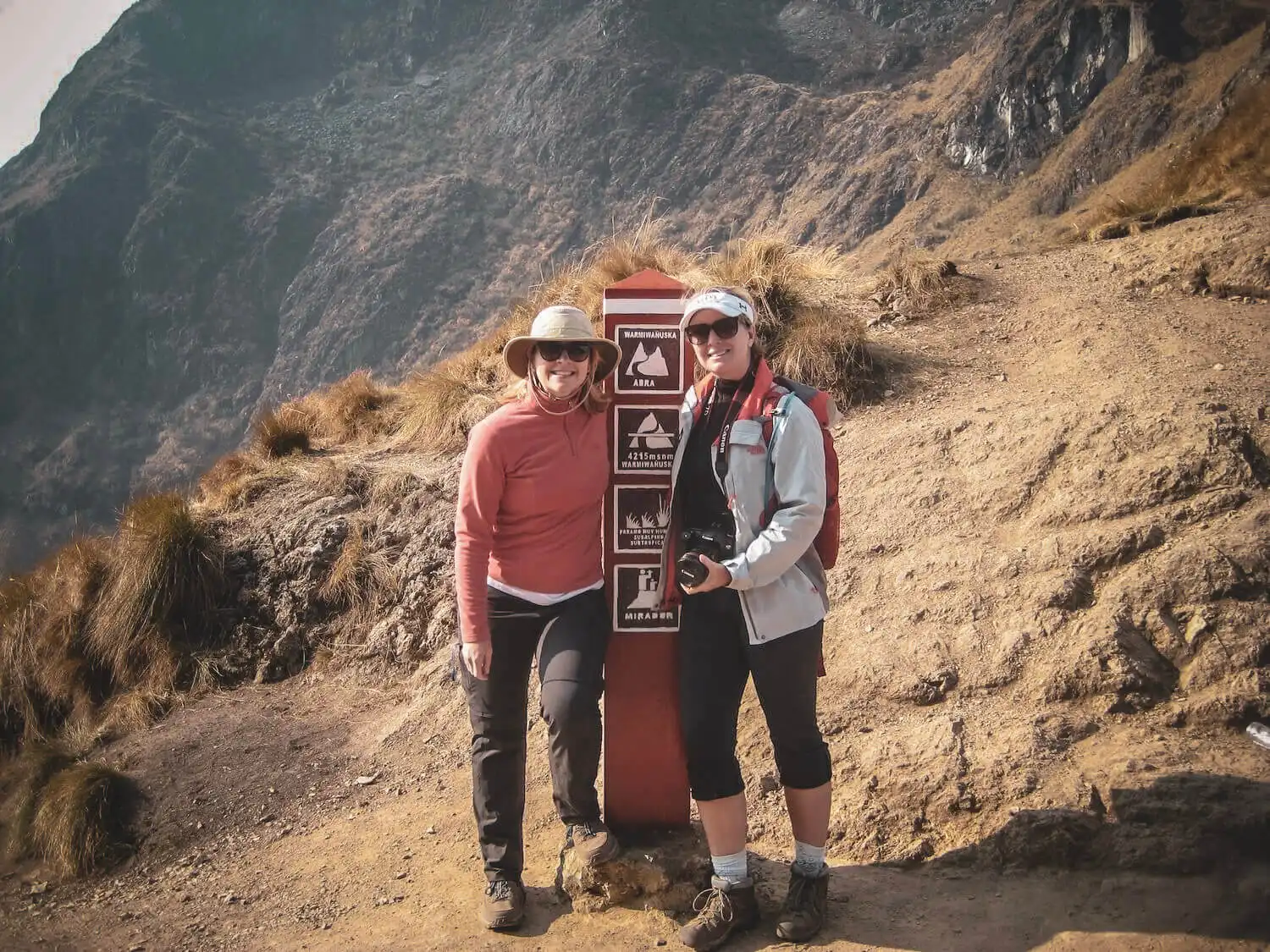
Fitness and preparation
Appearance, age and gym membership are poor measures of readiness. Walking endurance, leg strength, balance and recovery are more useful.
Before departure, aim to complete a full-day hilly walk with your planned daypack and remain capable of a moderate walk the following day.
| Readiness test | Ready | Needs more preparation |
|---|---|---|
| Complete a 15 km / 9 mi hilly walk | Finish tired but controlled | Unable to finish or exhausted |
| Climb stairs for 45–60 minutes | Keep a steady, sustainable pace | Need frequent extended stops |
| Complete a prolonged descent | Legs and foot placement stay controlled | Knees or quadriceps become unstable |
| Hike on consecutive days | Normal soreness allows a second active day | Day 1 prevents meaningful activity |
| Carry your planned daypack | Weight stays manageable for hours | Load changes your walking form |
Missing one benchmark does not mean the trek is impossible. It identifies what your training should address next.
A slower hiker who trained consistently on hills and stairs may be better prepared than a strong runner who has never practiced descending. Steady endurance, leg strength, balance, pacing and recovery matter more than speed.
Who tends to struggle?
For first-time trekkers
Previous multi-day trekking experience helps, but it is not mandatory. A beginner is more likely to be ready after progressively longer hikes, sustained stair sessions, downhill practice and at least one weekend of back-to-back walking.
See the training planThe honest verdict
You are likely physically ready if you can complete a full-day hill walk with your daypack and repeat a moderate hike the next day.
You can probably become ready with training if you exercise regularly but have little experience with hills, stairs or consecutive hiking days.
Prepare longer before booking if a moderate flat walk currently causes exhaustion, severe discomfort or several days of recovery.
Quick answers
These answers describe the common Classic four-day itinerary; route schedules and individual experience vary.
The Classic Inca Trail is a challenging to strenuous four-day hike. It requires no technical climbing, but high elevation, steep stone stairs, long descents and consecutive hiking days make it physically demanding.
The Day 2 climb to Dead Woman’s Pass is usually the hardest sustained effort. Day 3 can feel harder on the legs because of its long descent over uneven stone steps.
A common Classic four-day itinerary involves approximately 2,150 meters, or 7,050 feet, of cumulative ascent. The total varies with campsite allocation and the way the route is measured.
Yes, a prepared beginner can complete it. It is not an easy introductory hike, so preparation should include long walks, hills, stairs, descents and consecutive active days.
Elite fitness is unnecessary. You do need tested walking endurance, leg strength, balance and enough recovery to remain active on the following day.
No. It is a walking route rather than a technical climb. You do not need ropes, harnesses, mountaineering equipment or rock-climbing skills, although a few steep sections may require hands for balance.
Most days involve approximately five to ten hours of walking including normal breaks. Day 3 is often the longest, while Day 4 is usually limited to two or three hours of trail walking before the Machu Picchu visit.
Yes. Multi-day trekking experience is helpful but not essential. First-time trekkers should arrive having trained on hills and stairs, carried their intended daypack and completed back-to-back walking days.
Their height, depth and angle continually change, interrupting a natural stride. Uphill steps require repeated leg force, while downhill steps make the quadriceps control every drop.
Not always. Descending usually requires less cardiovascular effort, but it can be harder on the quadriceps and knees. The extended Day 3 descent is the clearest example.
Yes. A heavier load increases uphill effort and adds stress during descents. Train with approximately the same weight you plan to carry and avoid bringing items you will not use.
Complete a 15-kilometer hilly walk with your intended daypack. Finishing tired but in control is a useful sign; completing a second moderate walk the next day is a better test of four-day readiness.
No. Endurance, mobility, balance, leg strength, joint tolerance and recovery are more useful indicators than age alone.
It has fewer days and less accumulated fatigue than the Classic route, but still includes uphill walking and steep stone stairs. It should not be treated as an effortless walk.
The Classic route is hard enough to require specific preparation, especially for the Day 2 ascent and Day 3 descent, but it should feel achievable rather than impossible for a well-prepared traveler.
Our Cusco-based editorial team combines route knowledge, a comparison of common four-day profiles, official destination material and relevant exercise research. Daily values are planning estimates, not a promise of one operator’s campsite allocation.
Travel companies and publishers may cite these figures as approximate when linking to this guide and preserving the itinerary context and review date.
Data reviewed: August 5, 2026 · Editorial corrections: contact our team
Choose your next step
Check permits for your travel dates, or build the specific strength and endurance the route requires.