
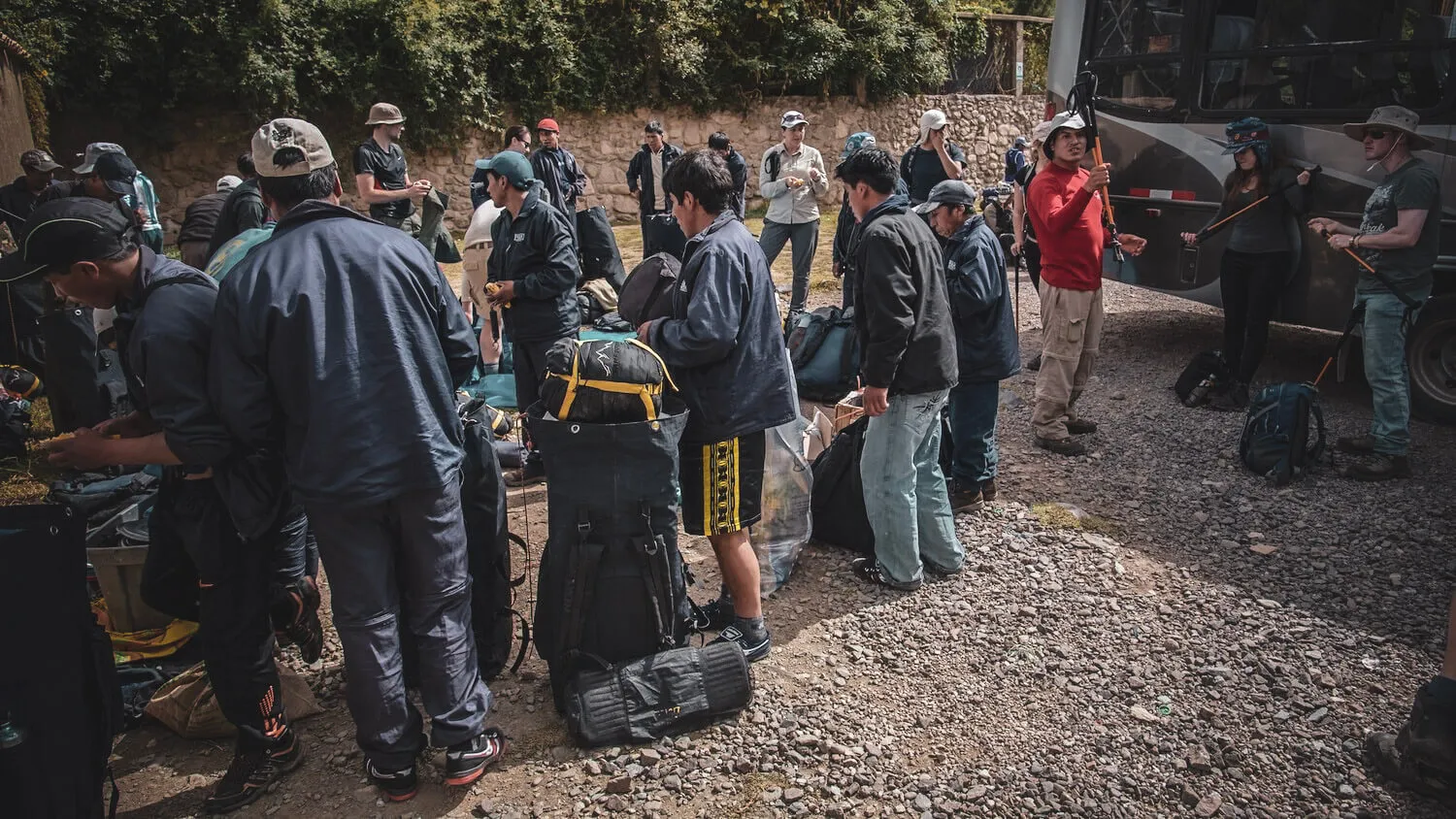
Inca Trail trekking team organizing luggage before departure

Porters, cooks and guides

Inca Trail tipping guide

Know what each recommendation means, calculate your group share and arrive at the final camp with enough divisible cash—not a compulsory fee.

4-day budget: about S/200–S/300 eachVoluntary, not mandatoryReviewed August 7, 2026

For a typical four-day Classic Inca Trail team, setting aside about S/200–S/300 per traveler is a sensible starting budget for good service.

It is a buffer, not a bill

Your actual contribution depends on how many travelers share the pool, how many professionals support the trek and whether the guide is calculated separately.

There is no official fixed gratuity. These ranges synthesize differing operator recommendations for planning and were reviewed in August 2026.

Read the unit before the number

Useful planning ranges

Porter and cook amounts are commonly quoted per worker but funded by the whole group. Guide amounts are often quoted per traveler. Mixing those units produces wildly incorrect totals.

RecipientPlanning rangeWhat the number means
PorterS/60–S/100Received by each porter from the trekking group as a whole
CookS/120–S/220Received by each cook from the trekking group as a whole
Lead guideS/60–S/80A useful contribution per traveler for the complete Classic trek
Traveler budgetS/200–S/300Useful total cash target per traveler for a typical four-day team

Local calculation only

Estimate your personal share

Start with a likely crew, then replace every number with the operator’s confirmed team at the pre-trek briefing.

Estimated personal contribution

S/180S/283Porter and cook pools divided between travelers, plus the selected guide contribution.
Support-crew pool: S/840–S/1,420Each traveler’s pool share: S/120–S/203

Planning tool only. It assumes S/60–S/100 received by each porter and S/120–S/220 by each cook from the group. It does not include assistant guides, exceptional direct tips or non-tip spending.

Why seven travelers do not pay the same as twelve

The group calculation, step by step

  1. 12 porters × S/60= S/720 group porter pool
  2. 1 cook × S/120= S/120 cook amount
  3. S/840 ÷ 7 travelers= S/120 each for the support crew
  4. Add S/60–S/80= about S/180–S/200 each including the guide

The same S/840 support pool divided between six travelers becomes S/140 each; divided between twelve, S/70. Crew size and traveler count must be considered together.

Inca Trail travelers and support crew assembled together at camp
Confirm the people actually assigned to your departure; a sample team cannot determine your tip.

Avoid omissions and double counting

How each part of the team is usually handled

Shared pool

Porters

A group amount is commonly divided across the porter team. A useful planning benchmark is S/60–S/100 received by each porter for the Classic trek.

If you hired a personal porter, ask whether that person participates in the same pool before adding a direct amount.
Often separate

Cook and assistants

The cook commonly receives a larger individual amount because there are fewer cooks and the role carries different responsibility. Confirm whether an assistant cook is included.

Usually later

Lead and assistant guides

Guides are commonly handled separately from the camp crew. Assess group management, interpretation, communication, safety decisions and support for different hiking speeds.

Pool or individual envelopes?

Both systems can work when distribution is transparent

A pool is convenient for a large team, but ask who receives it and how the total is divided. Direct tipping is useful for a personal porter or exceptional individual help, but can unintentionally exclude other workers.

Discuss the method with fellow travelers before the farewell gathering, not while the team waits.

A simple process

  1. Confirm the team and the units used.
  2. Agree on a voluntary group amount.
  3. Collect and count the money openly.
  4. Separate porter, cook and guide amounts.
  5. Confirm the recipient and distribution.
  6. Thank the team without turning the moment into pressure.
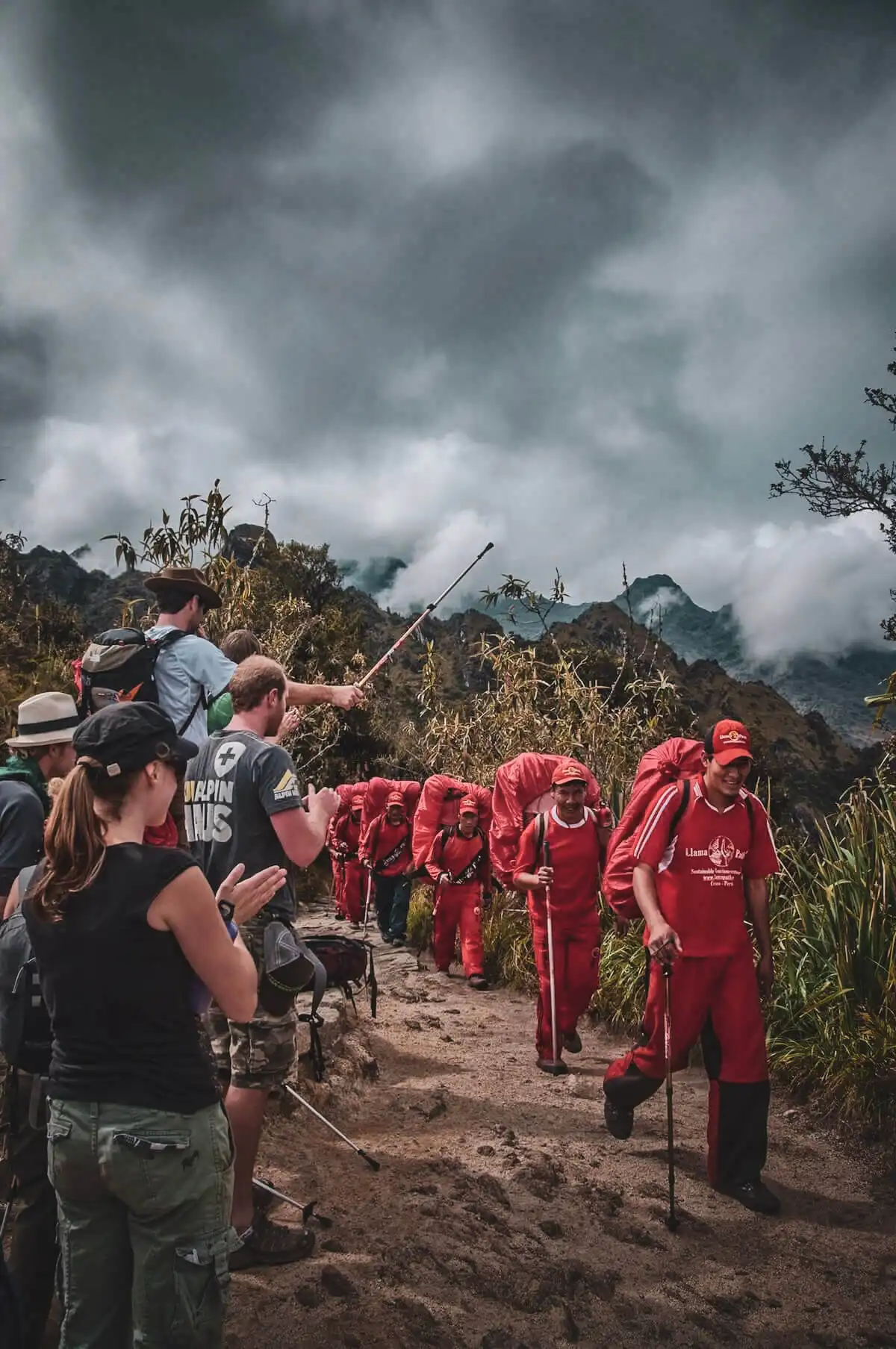
Loaded porter team passing travelers on the Inca Trail
The support crew may leave before your Machu Picchu visit, so prepare cash in Cusco.

Cash preparation

Use soles and do not wait for an ATM

  • Withdraw your estimated amount before leaving Cusco.
  • Prefer Peruvian soles unless the team requests otherwise.
  • Carry smaller, clean notes that are easy to divide.
  • Keep gratuities separate from emergency and personal spending cash.
  • Do not rely on cards, transfers or connectivity at camp.

Porter and cook tipping often happens at the final camp or meal before the support team separates. The guide will normally explain the exact timing.

Gratitude is not labor compliance

A larger tip cannot repair an unethical tour price

Peruvian law regulates porter loads, remuneration, food, equipment, insurance and overnight protection. Those costs belong in the operator’s business model.

Read the porter rights and load guide

Evaluate before booking

  • Total load calculation and weigh-in
  • Food, clothing and protective equipment
  • Sleeping tents, mats and bedding
  • Insurance and incident response
  • Statutory pay and overtime
  • Written complaints procedure

Cheap does not automatically mean abusive, and expensive does not prove responsibility. Ask for specific policies.

Short Inca Trail

Do not copy the four-day formula

Many two-day itineraries do not use the large porter-and-cook camping team required by the Classic trek. Some departures involve mainly a guide, transport and hotel logistics.

Some current planning sources suggest roughly S/100–S/120 per traveler overall, but staffing varies too much for that to be a default bill.

Ask who actually accompanies your departure, then tip that team.

Compare Short and Classic logistics

Remove uncertainty in Cusco

Eight questions for the briefing

A good operator explains the process without turning a suggested amount into social pressure.

  1. 01How many porters will our confirmed group have?
  2. 02How many cooks, assistant cooks and guides are included?
  3. 03Is your suggestion per traveler, per worker or from the group?
  4. 04Do trekkers create a pool or use individual envelopes?
  5. 05Who distributes a pool and how is the split explained?
  6. 06Are personal porters included or normally tipped separately?
  7. 07When does the support crew leave the group?
  8. 08Which currency and denominations are most practical?

Before leaving Cusco

Your tipping checklist

  • I know the confirmed number of staff and travelers.
  • I know whether each recommendation is per person, worker or group.
  • The group understands who will distribute the pool.
  • I have enough soles in divisible denominations.
  • My tip cash is separate from emergency money.
  • I understand that the final amount remains voluntary.

Quick answers

Inca Trail tipping FAQs

How much should I budget for tips on the four-day Inca Trail?

Around S/200–S/300 per traveler for all gratuities is a useful planning target for a typical Classic trek with good service. Group and crew size can move the result outside that range.

Is tipping mandatory?

No. Tipping is customary but voluntary. Suggested amounts are planning guidance, not a government tariff or an undisclosed compulsory charge.

How much should each porter receive?

A useful benchmark is approximately S/60–S/100 per porter from the trekking group as a whole. It usually does not mean every traveler gives that amount to every porter.

How much should the cook receive?

Published company guidance varies. S/120–S/220 per cook from the whole group is a practical planning range; confirm whether assistant cooks are separate.

How much should I tip the guide?

Around S/60–S/80 per traveler for the complete Classic trek is a useful reference, but some operators quote one combined group amount. Ask what the figure means before using it.

Should I tip in soles or US dollars?

Peruvian soles are usually simplest for local staff and smaller notes make pools easier to divide. Ask at the briefing, and carry cash before leaving Cusco.

When are tips given?

Porters and cooks are often thanked at the final camp or last meal before they separate from the group. Guides may be tipped later. The exact moment depends on the itinerary.

Should a personal porter be tipped separately?

You may tip them directly or include them in the pool, depending on the operator’s system. Confirm this in advance so the person is neither omitted nor counted twice.

Is the two-day tipping budget the same?

Usually not. A Short Inca Trail itinerary often has no full camping porter-and-cook team. Tip the professionals who actually accompany your departure rather than applying the four-day formula.

How these ranges were built

There is no official tipping tariff. We compared multiple current operator recommendations, normalized whether they were per traveler, per worker or per group, and present a range instead of endorsing one company’s policy.

Legal wages and conditions are sourced separately and must never be inferred from a gratuity recommendation.

Reviewed August 7, 2026 · Corrections: contact our editorial team

Tipping comes after the larger decisions

Find a date, then compare the complete operation

Permit availability, the chosen operator and the confirmed team determine the itinerary and your real cash plan.

Check permit availabilityCompare operators